Tampilkan postingan dengan label points. Tampilkan semua postingan

New APK Market iMarketApk » Doodle Creatures HD v2 3 22 Unlimited Points

Sabtu, 17 Desember 2016

0 komentar
Doodle Creatures HD v2.3.22 [Unlimited Points]

Requirements

http://iMarketApk.blogspot.com/ [New] APK Market iMarketApk » Doodle Creatures HD v2.3.22 [Unlimited Points] [Torrent Modded apk] Free APK are available on every other topic you can think of in both fiction and non-fiction of. There are free Android APK available for adults and children and even between and teenagers. It may seem overwhelming to find and download [android apk] Hack no survey [New] APK Market iMarketApk » Doodle Creatures HD v2.3.22 [Unlimited Points] ҩ MOD but with the steps below youll be just minutes away from getting APK.: Android OS 2.3.3 and up

http://iMarketApk.blogspot.com/ - Overview about Doodle Creatures HD v2.3.22 [Unlimited Points]

Full Download MOd [New] APK Market iMarketApk » Doodle Creatures HD v2.3.22 [Unlimited Points] and Torrent Link

: Play God & Create an Amazing Creature Universe!
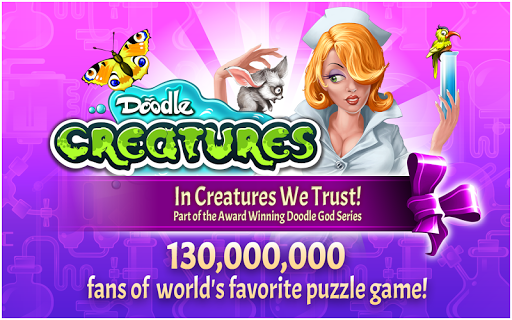
From the creators of the award winning puzzler Doodle God, comes a new

ALL ages adventure!

What happens if you combine an elephant with a flamingo?

In Doodle Creatures you can find out as you create hundreds of fantastic and unique Creatures by combining different animals.

Play Doctor and scan hundreds of animals DNA which allows you to combine different animal traits to create new Creatures.

Take the speed of a cheetah and combine with flying ability of an eagle.

Awesomeness awaits!

Along the way, build and upgrade your own genetic laboratory that gives you the power to build an even more spectacular Creature Universe of your imagination!

OVER 130,000,000 PLAYERS WORLDWIDE FOR THE DOODLE SERIES!

GAME FEATURES

* Puzzles for All ages and skill levels.

* Create hundreds of different Creatures in cool sandbox game play.

*Clever Quests designed to test your skill.


* Build and upgrade your own genetic laboratory.

* Cool “Did You Know That” feature that tells you about your creations.

*Intuitive one-click game play encourages thoughtful, creative play.

* Hundreds of interesting, funny and thought-provoking quotes and sayings.

* Kid-friendly and educational game play!

Whats New

-Bug fixed

More Info Doodle Creatures HD v2.3.22 [Unlimited Points]

You can directly download the apk file with torent modded or just in iMarketApk

Android APK Files [New] APK Market iMarketApk » Doodle Creatures HD v2.3.22 [Unlimited Points] Full And No Hack No Survey No ROOT

:

https://play.google.com/store/apps/d...lecreatures_hd

Download Instructions: opera-fan

Download Url

Download Url

Download Url

Not modded:

Download Url

Download Url

Download Url

Read More..

Random points on a unit sphere in OSL code and benchmarks

Jumat, 17 Januari 2014

0 komentar

In preparation to adapting the wood knot shader to have randomly oriented cylindrical knots rather than spherical knots I needed a function that generates vectors that are uniformly distributed over the surface of a unit sphere. This is not as simple as creating a vector with three random components but several methods exist that will produce vectors with a correct distribution.

A straight forward method (implemented in the function random_sphere() shown below) consists of generating correctly distributed spherical coordinates and the converting them to cartesian coordinates. This works fine but because trigonometric functions (like acos() and sincos()) used here) may be expensive, several alternatives exist that do not use these functions.

In the code presented here we have implemented the methods of Marsaglia (random_sphere1()) and Cook (random_sphere2()). Both are rejection methods: they discard some random numbers when they would lead to invalid vectors. This is wasteful so the question is: are these methods really more efficient on modern hardware where trigonometric functions are implemented as cpu operations?

Some timings

The timings presented below were measured on a 64-bit Amd 6-core cpu with the shader provided below. They might be completely different for other CPUs and probably even more so once OSL shaders will be able to run on a GPU.

nrandom_sphererandom_sphere1 random_sphere2
100 3.6 3.4 7.5
500 10.4 10.1 -
First thing to note is that the timings for 100 and 500 vectors do not scale proportionally because some of the dots we draw with our shader overlap, effectively reducing the number of vectors we have to generate for each shading sample. The other thing is that random_sphere2 is much slower than the other implementations, probably because we generate more random numbers and reject a lot more combinations.

As for the difference between the other two methods: the difference is probably significant but too small to make a real difference on my CPU. Ill probably check again when I get another CPU or OSL shaders will run on a GPU, but for now I stick with the most straightforward method.

Code and node setup


// generate random unit vectors randomly distributed over a sphere
// straight forward method
vector random_sphere(point p, int n){
float t = M_2PI*noise("cell",p,n*2+0);
float u = 2*noise("cell",p,n*2+1)-1;
float s,c,a;
sincos(t,s,c);
a = sqrt(1-u*u);
float x = a*c;
float y = a*s;
float z = u;
return vector(x,y,z);
}

// marsaglias method
vector random_sphere1(point p, int m){
vector v = 0;
float repeat = 0;
int n = m + 1;
while(1){
repeat++;
float r0 = 2*noise("cell",p,repeat*n*2+0)-1;
float r1 = 2*noise("cell",p,repeat*n*2+1)-1;
float r02 = r0*r0;
float r12 = r1*r1;
float sr2 = r02 + r12;
if( sr2 < 1 ){
float x = 2*r0*sqrt(1-r02-r12);
float y = 2*r1*sqrt(1-r02-r12);
float z = 1-2*sr2;
v = vector(x,y,z);
break;
}
}
return v;
}

// cooks method
vector random_sphere2(point p, int m){
vector v = 0;
float repeat = 0;
int n = m + 1;
while(1){
repeat++;
float r0 = 2*noise("cell",p,repeat*n*4+0)-1;
float r1 = 2*noise("cell",p,repeat*n*4+1)-1;
float r2 = 2*noise("cell",p,repeat*n*4+2)-1;
float r3 = 2*noise("cell",p,repeat*n*4+3)-1;
float r02 = r0*r0;
float r12 = r1*r1;
float r22 = r2*r2;
float r32 = r3*r3;
float sr2 = r02 + r12 + r22 + r32;
if( sr2 < 1 ){
float x = 2*(r1*r3 + r0*r2)/sr2;
float y = 2*(r2*r3 - r0*r1)/sr2;
float z = (r02 + r32 - r12 - r22)/sr2;
v = vector(x,y,z);
break;
}
}
return v;
}

shader sphere_test(
vector p = P,
int n = 100,
float R = 0.03,
int method = 0,

output float Fac = 0
){
for(int i=0; i < n; i++){
vector v = 0;
if( method == 0 ){
v= random_sphere(point(0,0,0),i);
}else if( method == 1){
v= random_sphere1(point(0,0,0),i);
}else{
v= random_sphere2(point(0,0,0),i);
}
if( distance(point(0,0,0),1000*v,p ) < R ){
Fac = 1;
break;
}
}
}

The way we generate random numbers might seem strange but not only do we want to be able to generate any number of vectors for a given cell but in the rejection methods we also want to be able to generate replacements that are guaranteed to be different, hence the multiplication by the number of times we have to repeat.

The image shows the node setup used to verify the shader and time the different implementtations

Read More..

Copyright © 2010-2022 Kabar Blog | Powered By Blogger